
주요 서비스 메뉴

Multi-dense facility fire scenario based early warning and evacuation system development (Korea Institute of Civil Engineering and Building Technology)
Multi-dense facility fire scenario based early warning and evacuation system development
- Policy features
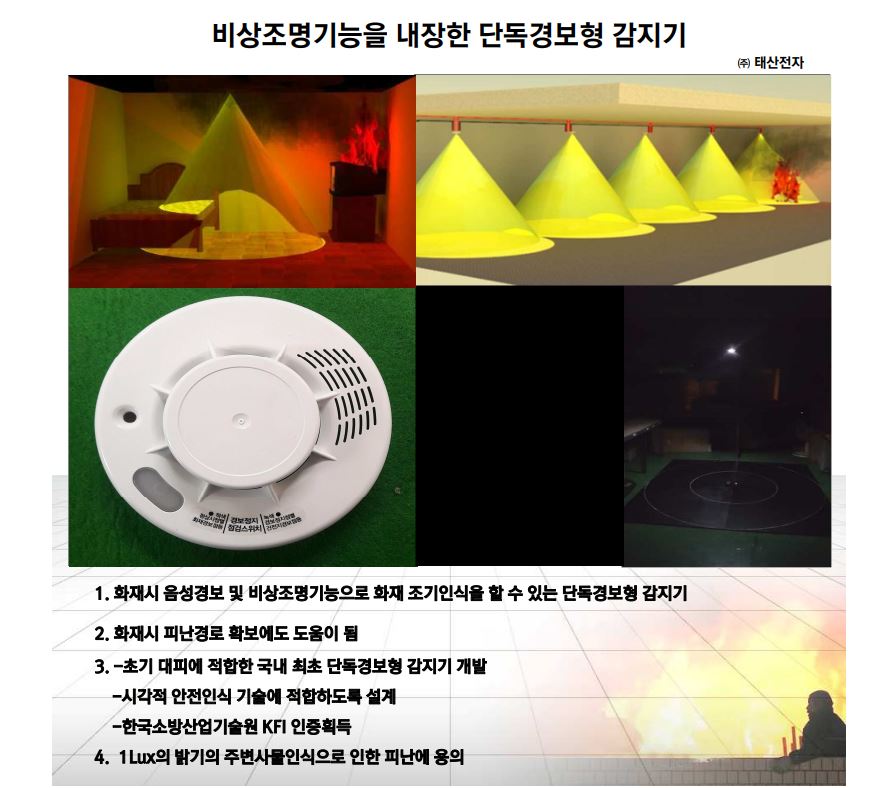
Most of the fatalities in residential fires occur at night and at bedtime, and the cause of this is the reason why the fire occurred during bedtime was not immediately recognized, but it can be caused by panic due to darkening and failure to secure the view of evacuation. Developed a new-concept single-alarm-type detector that incorporates the emergency lighting function and voice function of a single-alarm-type detector in combination to prevent an evacuation failure and minimize fire damage through an alarm through prompt detection and an evacuation field of view through lighting of emergency lighting. It can be used as an advanced fire fighting product.
- Policy details
- Government Organization Information
- Other Policys of
this Government Organization - Related recommended policys
Policy details

-The most common characteristic of a house fire is that if a fire occurs, there is a very high probability of human injury than other places. This is because detached houses that are not subject to the installation of automated fire detection facilities and apartment houses with a total floor area of less than 1,000 m2 are exposed to fire unprotected because they do not have even basic firefighting facilities beyond early detection and warning of fire.
-Most of the fatalities in residential fires occur at night and at bedtime, and the cause of this is the reason why the fire occurred during bedtime was not immediately recognized, but it can be caused by panic due to darkening and failure to secure the view of evacuation. Developed a new-concept single-alarm-type detector that incorporates the emergency lighting function and voice function of a single-alarm-type detector in combination to prevent an evacuation failure and minimize fire damage through an alarm through prompt detection and an evacuation field of view through lighting of emergency lighting. It can be used as an advanced fire fighting product.
-Fire detection is possible for both hearing and visually impaired by improving performance considering the fire vulnerable
-Obtained KFI certification from Korea Fire Industry Technology Institute by developing a single alarm type detector equipped with an emergency lighting function for the first time in Korea
-Emergency lighting: Maintain 1Lux or more per section, service life: 10 years, sound/voice: 85dB/70dB
-Patent registration for "Fire Detector"
-Expandable installation targets as products applicable not only to houses but also to all places vulnerable to fire
- Policy details
- Government Organization Information
- Other Policys of
this Government Organization - Related recommended policys
Government Organization Information

한국건설기술연구원Korea Institute of Civil Engineering and Building Technology
Address : 283, Goyang-daero, Ilsanseo-gu, Goyang-si, Gyeonggi-do, 10223, Rep. of Korea
Website : http://www.kict.re.kr
Through the nation’s industrialization and rapid growth, the Korean construction industry has grown equal to that in advanced countries. Recently, we have been seeing the emergence of new talking points in construction beyond the conventional topics of building, civil engineering, and social infrastructure. These include smart city infrastructure in the era of the Fourth Industrial Revolution, convergent technologies in emerging fields, for example, construction technologies for extreme environments, and relevant institutions and policies.
We at the KICT will exert our utmost efforts to answer these needs of the times and ensure the convenient, safe, and healthy lives of citizens. We aim to resolve the current issues and challenges in construction technology to allow citizens to live more convenient, safe, and healthy lives in our land and residential environment, make bold challenges to future issues, and present visions to improve the competitiveness of the homeland and society’s potential for innovative growth, thereby contributing to improving the quality of citizens’ lives.
Other Policys of
this Government Organization
-
 Multi-dense facility fire scenario based early warning and evacuation system development
-
 Multi-dense facility fire scenario based early warning and evacuation system development
-
 Multi-dense facility fire scenario based early warning and evacuation system development
-
 Multi-dense facility fire scenario based early warning and evacuation system development
- Policy details
- Government Organization Information
- Other Policys of
this Government Organization - Related recommended policys
Related recommended policys
-
Multi-dense facility fire scenario based early warning and evacuation system development
-
 SmartVEAS(Smart Video Evacuation Assistance System)
-
Multi-dense facility fire scenario based early warning and evacuation system development
-
Multi-dense facility fire scenario based early warning and evacuation system development
-
Multi-dense facility fire scenario based early warning and evacuation system development
-
Multi-dense facility fire scenario based early warning and evacuation system development
-
SmartVEAS(Smart Video Evacuation Assistance System)
-
Multi-dense facility fire scenario based early warning and evacuation system development
-
Multi-dense facility fire scenario based early warning and evacuation system development
-
Multi-dense facility fire scenario based early warning and evacuation system development
Inquiry for participation (companies) T. +82-31-995-8724 / 8746 / 8092 Inquiry for participation T. +82-31-995-8270 / 8724
COPYRIGHT (C) K-SAFETY EXPO 2020. ALL RIGHTS RESERVED.
