주요 서비스 메뉴

Multi-dense facility fire scenario based early warning and evacuation system development (Korea Institute of Civil Engineering and Building Technology)
Multi-dense facility fire scenario based early warning and evacuation system development
- Policy features
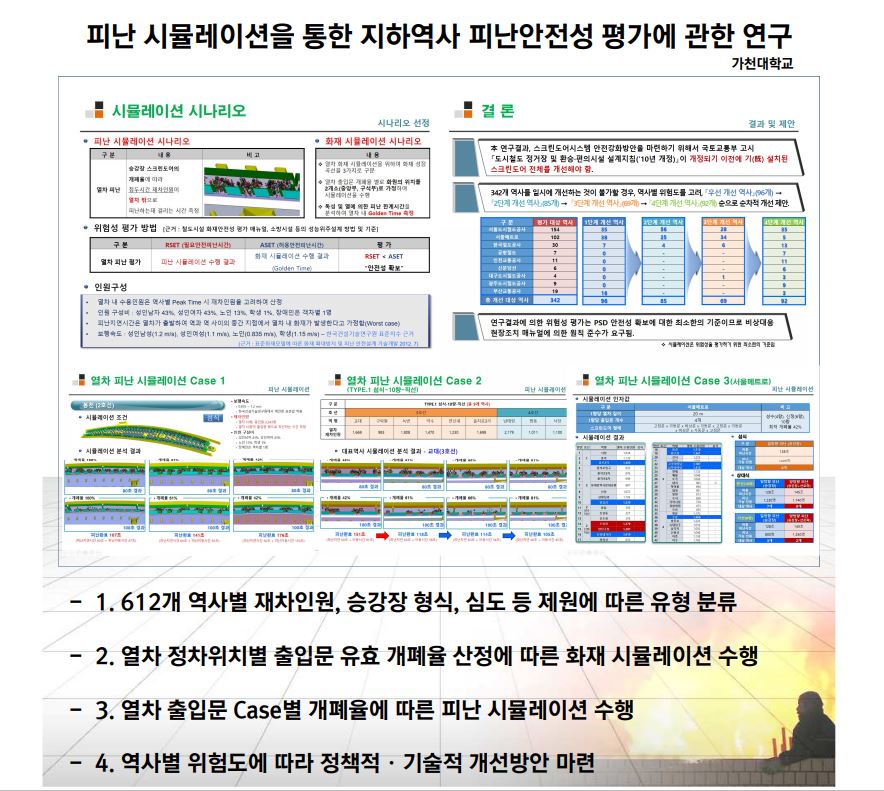
In order to create a simulation scenario, a case study of domestic and foreign subway fires, analysis and related research results, and a literature survey were conducted, and the current status of subway stations and classification were completed.
- Policy details
- Government Organization Information
- Other Policys of
this Government Organization - Related recommended policys
Policy details

In order to create a simulation scenario, a case study, analysis, related research results, and literature survey were conducted in domestic and overseas subway fires, and the current status of subway stations and classification were completed.
The simulation analysis according to the scenario proceeded as follows. Evacuation due to toxicity and heat by calculating the effective opening/closing rate of the train entrance door by train stop location (fixed position, less than 4m stop (effective open/close rate 61%), stop less than 7m (effective open/close rate 42%)) By analyzing the limit time, the Golden Time in each type of train was derived.
In case of emergency, evacuation completion time was derived by conducting an evacuation simulation taking into account the historical status such as the effective opening/closing rate of the train entrance door according to the train stop location, by the number of passengers, and by screen door type. According to NFPA 130 and 「Guidelines for Complementary Design Guidelines for Urban Railway Stations and Transit Facilities」, the degree of risk was derived by comparing and analyzing whether evacuation was completed within 4 minutes of evacuation at the platform and within 6 minutes of evacuation at the station.
Based on the derivation of 342 subway stations risk levels, the following are the ways to improve the screen door of the subway platform in order to prepare a plan to strengthen the safety of the screen door system. When the train is out of the correct position error range, automatic opening by the control panel is prohibited and the principle of manual opening by passengers has been established. In addition, when it is impossible to improve 342 stations at once, policy improvement measures were prepared according to the risk of each station. Improvement methods are required in the order of step 1→step 2→step 3→step 4.
There is a need to improve public relations for the use of emergency doors and manuals for operating institutions. To improve the ability to cope with emergency situations while using public transportation, such as expanding education and publicity so that passengers can escape by opening the emergency door directly when the train fails to stop at the correct location, and including it in the elementary school curriculum. Policy support is required.
- Policy details
- Government Organization Information
- Other Policys of
this Government Organization - Related recommended policys
Government Organization Information

한국건설기술연구원Korea Institute of Civil Engineering and Building Technology
Address : 283, Goyang-daero, Ilsanseo-gu, Goyang-si, Gyeonggi-do, 10223, Rep. of Korea
Website : http://www.kict.re.kr
Through the nation’s industrialization and rapid growth, the Korean construction industry has grown equal to that in advanced countries. Recently, we have been seeing the emergence of new talking points in construction beyond the conventional topics of building, civil engineering, and social infrastructure. These include smart city infrastructure in the era of the Fourth Industrial Revolution, convergent technologies in emerging fields, for example, construction technologies for extreme environments, and relevant institutions and policies.
We at the KICT will exert our utmost efforts to answer these needs of the times and ensure the convenient, safe, and healthy lives of citizens. We aim to resolve the current issues and challenges in construction technology to allow citizens to live more convenient, safe, and healthy lives in our land and residential environment, make bold challenges to future issues, and present visions to improve the competitiveness of the homeland and society’s potential for innovative growth, thereby contributing to improving the quality of citizens’ lives.
Other Policys of
this Government Organization
-
 Multi-dense facility fire scenario based early warning and evacuation system development
-
 Multi-dense facility fire scenario based early warning and evacuation system development
-
 Multi-dense facility fire scenario based early warning and evacuation system development
-
 Multi-dense facility fire scenario based early warning and evacuation system development
- Policy details
- Government Organization Information
- Other Policys of
this Government Organization - Related recommended policys
Related recommended policys
-
Multi-dense facility fire scenario based early warning and evacuation system development
-
Multi-dense facility fire scenario based early warning and evacuation system development
-
 SmartEGS(Smart Evacuation Guidence System)
-
Multi-dense facility fire scenario based early warning and evacuation system development
-
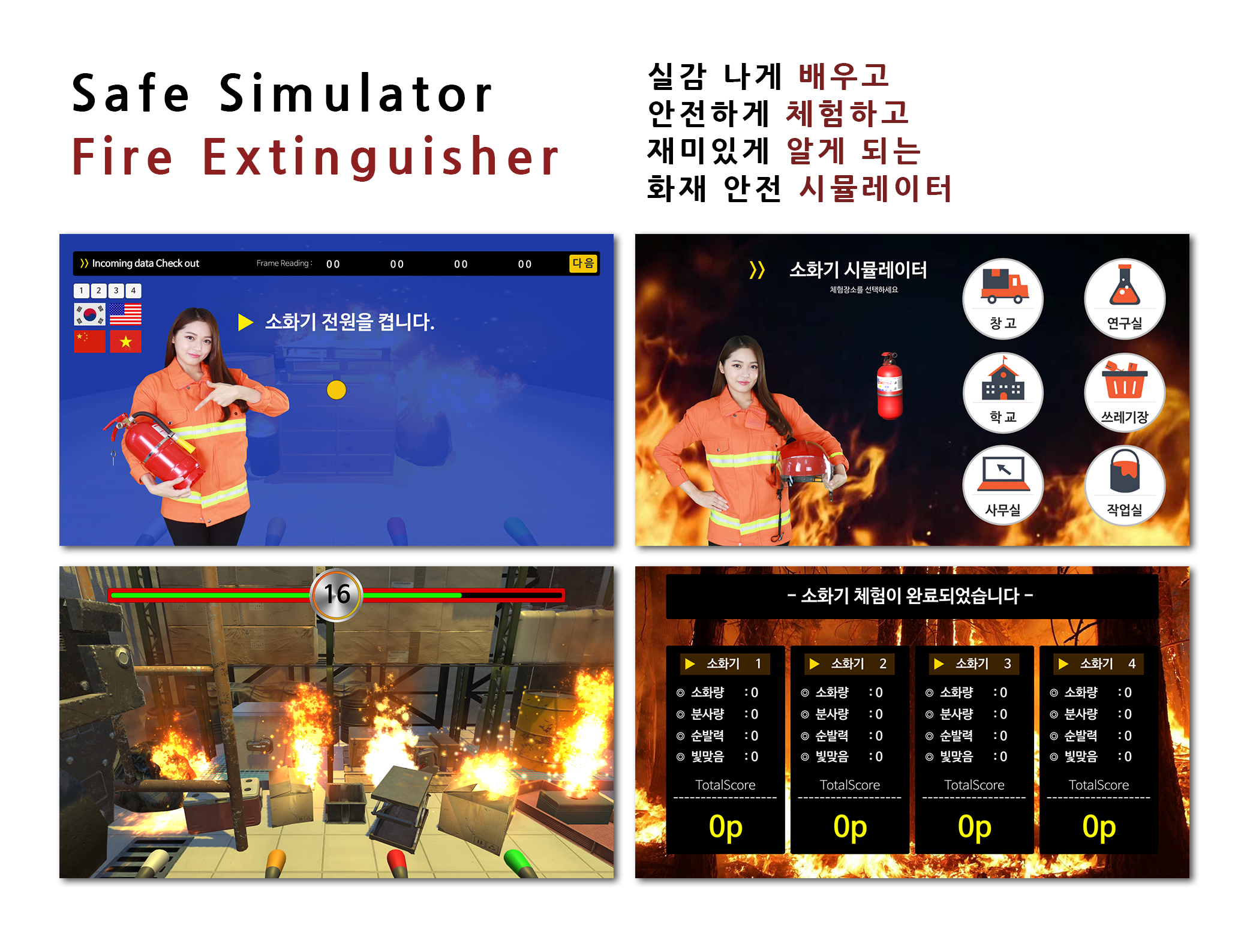 fire extinguisher simulator
-
Multi-dense facility fire scenario based early warning and evacuation system development
-
Multi-dense facility fire scenario based early warning and evacuation system development
-
SmartEGS(Smart Evacuation Guidence System)
-
Multi-dense facility fire scenario based early warning and evacuation system development
-
fire extinguisher simulator
Inquiry for participation (companies) T. +82-31-995-8724 / 8746 / 8092 Inquiry for participation T. +82-31-995-8270 / 8724
COPYRIGHT (C) K-SAFETY EXPO 2020. ALL RIGHTS RESERVED.
