
주요 서비스 메뉴

Multi-dense facility fire scenario based early warning and evacuation system development (Korea Institute of Civil Engineering and Building Technology)
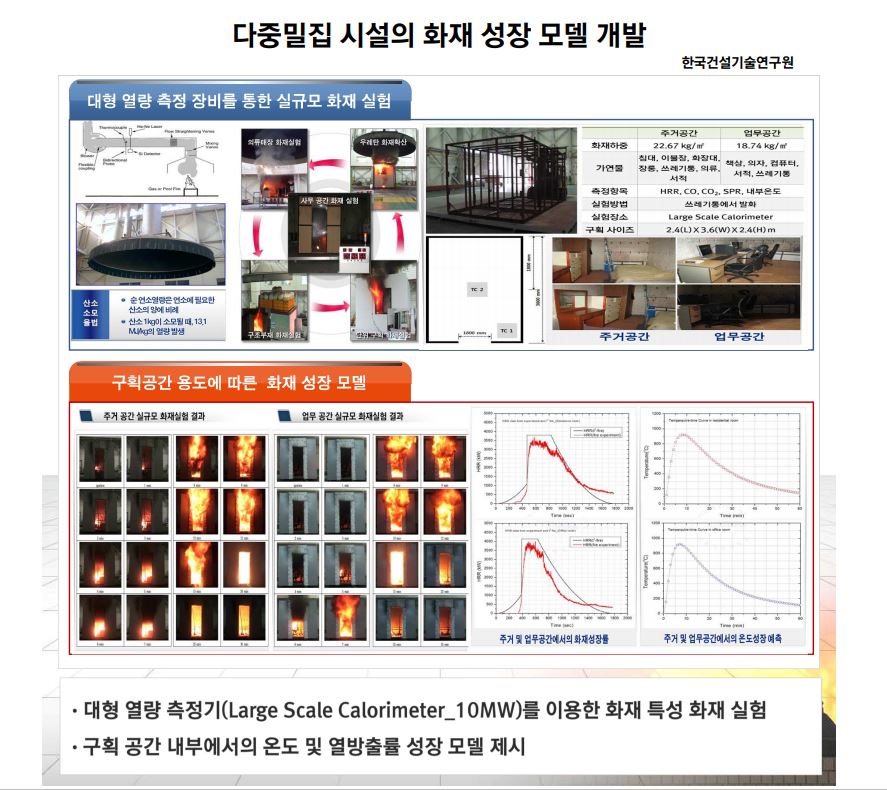

Multi-dense facility fire scenario based early warning and evacuation system development
- Policy features
The fire growth model inside the divided space can be used as basic data for predicting the spread of fire in the entire building, and through this, appropriate protection designs inside and outside the building can be presented.
- Policy details
- Government Organization Information
- Other Policys of
this Government Organization - Related recommended policys
Policy details

Various protection designs are in progress in order to respond to fire accidents occurring in buildings, and in such a design, it is necessary to first predict the growth of fires suitable for the characteristics of the partition space of the building.
This fire growth model was developed using data of temperature and heat release rate through a real-scale fire test conducted in a large scale calorimeter (LSC), a large-scale 10 MW-class calorimeter. In the full-scale fire test, a section frame of size 2.4(L)×3.6(W)×2.4(H) m was constructed and combustibles were placed inside, and heptane was used as an initial complex.
Through the experimental data, the change in the heat release rate was presented in the growth, peak and decline period using the t2 curve, and the model for the change in temperature was developed in about 7-8 minutes using the BFD curve.
The fire growth model inside the divided space can be used as basic data for predicting the spread of fire in the entire building, and through this, appropriate protection designs inside and outside the building can be presented.
- Policy details
- Government Organization Information
- Other Policys of
this Government Organization - Related recommended policys
Government Organization Information

한국건설기술연구원Korea Institute of Civil Engineering and Building Technology
Address : 283, Goyang-daero, Ilsanseo-gu, Goyang-si, Gyeonggi-do, 10223, Rep. of Korea
Website : http://www.kict.re.kr
Through the nation’s industrialization and rapid growth, the Korean construction industry has grown equal to that in advanced countries. Recently, we have been seeing the emergence of new talking points in construction beyond the conventional topics of building, civil engineering, and social infrastructure. These include smart city infrastructure in the era of the Fourth Industrial Revolution, convergent technologies in emerging fields, for example, construction technologies for extreme environments, and relevant institutions and policies.
We at the KICT will exert our utmost efforts to answer these needs of the times and ensure the convenient, safe, and healthy lives of citizens. We aim to resolve the current issues and challenges in construction technology to allow citizens to live more convenient, safe, and healthy lives in our land and residential environment, make bold challenges to future issues, and present visions to improve the competitiveness of the homeland and society’s potential for innovative growth, thereby contributing to improving the quality of citizens’ lives.
Other Policys of
this Government Organization
-
 Multi-dense facility fire scenario based early warning and evacuation system development
-
 Multi-dense facility fire scenario based early warning and evacuation system development
-
 Multi-dense facility fire scenario based early warning and evacuation system development
-
 Multi-dense facility fire scenario based early warning and evacuation system development
- Policy details
- Government Organization Information
- Other Policys of
this Government Organization - Related recommended policys
Related recommended policys
-
Multi-dense facility fire scenario based early warning and evacuation system development
-
Multi-dense facility fire scenario based early warning and evacuation system development
-
Multi-dense facility fire scenario based early warning and evacuation system development
-
 INNILO FIRE SAFETY SYSTEM
-
Multi-dense facility fire scenario based early warning and evacuation system development
-
Multi-dense facility fire scenario based early warning and evacuation system development
-
Multi-dense facility fire scenario based early warning and evacuation system development
-
Multi-dense facility fire scenario based early warning and evacuation system development
-
INNILO FIRE SAFETY SYSTEM
-
Multi-dense facility fire scenario based early warning and evacuation system development
Inquiry for participation (companies) T. +82-31-995-8724 / 8746 / 8092 Inquiry for participation T. +82-31-995-8270 / 8724
COPYRIGHT (C) K-SAFETY EXPO 2020. ALL RIGHTS RESERVED.
